


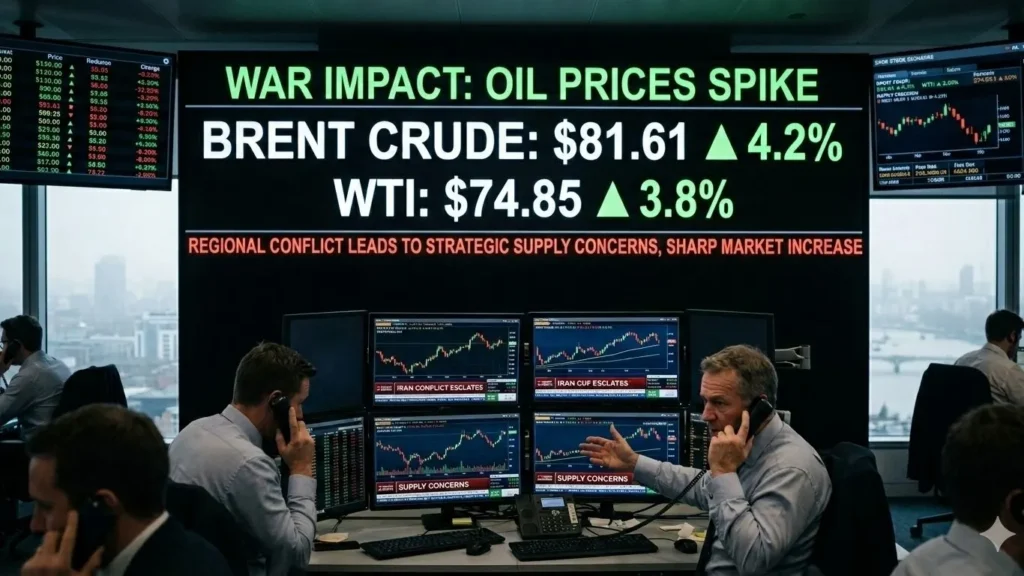
The global economy is once again on edge as the oil price surges to its highest level in over a year. Markets are reacting sharply to rising geopolitical tensions in the Middle East, supply disruptions, and fears of a prolonged energy crisis.
From Brent crude nearing the $80–$82 mark to WTI climbing above $70, the sudden oil price spike has sparked concerns about inflation, fuel costs, and the possibility of a global slowdown.
But what is really driving this dramatic oil price surge? Below are nine dangerous signals that explain why the market is heating up — and why it matters to everyone from governments to everyday consumers.
Table of Contents
1. Escalating Middle East Military Conflict
The biggest trigger behind the oil price surge is rising military tension involving the United States, Israel, and Iran. The situation has reportedly moved from indirect confrontations to direct retaliatory strikes.
Energy markets react immediately to conflict in the Middle East because the region supplies a significant portion of the world’s oil. Even the threat of further escalation adds a strong “risk premium” to the oil price.


When geopolitical stability weakens, oil markets rarely stay calm.
2. Strait of Hormuz Disruption Fears
A major warning signal is the reported disruption of shipping in the Strait of Hormuz — the world’s most critical oil chokepoint.
Roughly 20% of global oil supply passes through this narrow waterway every day. If access is limited or blocked, the global oil price can skyrocket within hours.
Reports suggest more than 150 oil tankers are either anchored or rerouting to avoid potential attacks. Insurance coverage for vessels operating in the region has also become more expensive.
Any prolonged closure of this strategic passage could send the oil price well beyond current levels.
3. Physical Infrastructure Under Threat
Markets are not only worried about shipping routes — they are also concerned about oil infrastructure damage.
Drone strikes and security threats targeting major refineries and export facilities have increased fears of physical supply losses. For example, facilities operated by Saudi Aramco have reportedly faced risk alerts in recent days.
Even if actual damage remains limited, the possibility alone pushes the oil price higher. Traders price in worst-case scenarios long before confirmed supply losses occur.
4. The $10–$12 War Risk Premium
Energy analysts estimate that the current oil price includes an additional $10–$12 per barrel in what is known as a “war premium.”
This means prices are being driven not just by real supply cuts, but by speculation about what could happen next.
When markets operate under fear, volatility increases sharply. Investors rush to secure contracts before prices climb further, creating a self-reinforcing cycle of buying pressure.
As long as uncertainty remains high, this risk premium is unlikely to disappear.
5. Inflation Pressures on Major Economies
Rising oil price levels have direct consequences for inflation.
Countries like India, China, and many European nations rely heavily on imported oil. Every $10 increase per barrel can significantly raise transportation and manufacturing costs.
Higher fuel prices often lead to:
- Increased food costs
- Higher logistics expenses
- Rising airline ticket prices
- Slower economic growth
Central banks trying to control inflation may delay interest rate cuts if oil price pressures continue. This adds another layer of economic stress globally.
6. Shipping and Logistics Costs Soaring
With tanker routes disrupted, shipping companies are forced to take longer, alternative paths.
This increases:
- Fuel consumption
- Transit time
- Insurance premiums
- Freight rates
Marine insurance costs in conflict zones have reportedly jumped significantly. These extra expenses ultimately get passed on to consumers.
The oil price surge does not stay limited to crude markets — it spreads across the entire supply chain.
7. Natural Gas Prices Also Jumping
The energy crisis is not limited to oil.
Benchmark European natural gas prices recently jumped sharply after production concerns in the Gulf region. Energy companies such as QatarEnergy have reportedly adjusted operations due to regional instability.
When both oil price and natural gas prices rise together, the global energy system feels double pressure.
Electricity bills increase. Industrial production becomes more expensive. Governments may need to offer subsidies, which strains public finances.
8. OPEC+ Output Increase Insufficient
The oil-producing alliance OPEC+ recently agreed to increase production modestly in April.
However, analysts describe the planned increase as relatively small compared to potential supply disruptions from the Middle East.
If major exporters cannot safely ship oil, a modest production hike elsewhere may not be enough to balance the market.
In short, supply risks currently outweigh planned supply additions.
9. Growing Fear of $100 Oil
Perhaps the most dangerous signal behind the oil price surge is growing speculation that crude could cross $100 per barrel.
Major financial institutions have outlined two possible scenarios:
De-escalation Scenario:
If diplomatic efforts succeed and tensions ease, oil price levels could gradually return to the $60–$70 range.
Full Blockade Scenario:
If the Strait of Hormuz remains blocked for an extended period, Brent crude could surge to $100–$120 per barrel.
Such a spike could trigger:
- Global inflation surge
- Slower economic growth
- Possible recession in vulnerable economies
Markets are currently pricing in uncertainty — and uncertainty keeps oil price volatility high.
How the Oil Price Surge Affects Everyday People
The oil price may seem like a technical financial topic, but its impact is deeply personal.
1. Petrol and Diesel Prices Rise
Consumers feel the impact immediately at fuel stations.
2. Higher Transportation Costs
Taxi fares, bus tickets, and airline prices increase.
3. Increased Food Prices
Food distribution depends heavily on fuel-powered transport.
4. Rising Electricity Bills
In many countries, power generation is linked to oil and gas prices.
5. Slower Job Growth
Businesses facing higher costs may delay hiring.
In short, the oil price surge affects nearly every part of daily life.
What Could Happen Next?
The future direction of oil price movements depends largely on geopolitical developments.
If diplomatic talks reportedly opening in Oman succeed, tensions could ease, and markets may stabilize.
However, if conflict intensifies and shipping remains disrupted, volatility could continue for weeks or even months.
Investors, policymakers, and consumers are all watching developments closely.
Is This the Start of a New Energy Crisis?
Some analysts compare the current oil price surge to previous energy shocks.
However, today’s global economy is somewhat more diversified, with renewable energy playing a larger role than in past decades.
Still, oil remains central to transportation and industrial production.
A prolonged disruption could test global economic resilience once again.
Conclusion
The oil price surge is not happening in isolation. It reflects deeper geopolitical instability, fragile supply chains, and economic uncertainty.
The nine dangerous signals — from Middle East conflict to shipping disruptions and inflation risks — all point toward heightened volatility in the coming weeks.
Whether oil price levels retreat or climb toward $100 depends on diplomatic outcomes and supply stability.
For now, markets remain tense, and the world is closely monitoring every development in th
Why is the oil price rising so quickly?
The oil price is rising due to Middle East tensions, shipping disruptions, and supply fears.
Could oil price reach $100 per barrel?
Yes, if the Strait of Hormuz remains blocked or conflict escalates.
How does rising oil price affect inflation?
Higher oil price increases transportation and production costs, raising overall inflation.
Will OPEC+ production increases help?
The planned increase may not fully offset major supply disruptions.
Should consumers expect higher fuel prices soon?
If the oil price remains elevated, fuel costs are likely to rise globally.


