Moon Eclipse 2026: Stunning Blood Moon Night
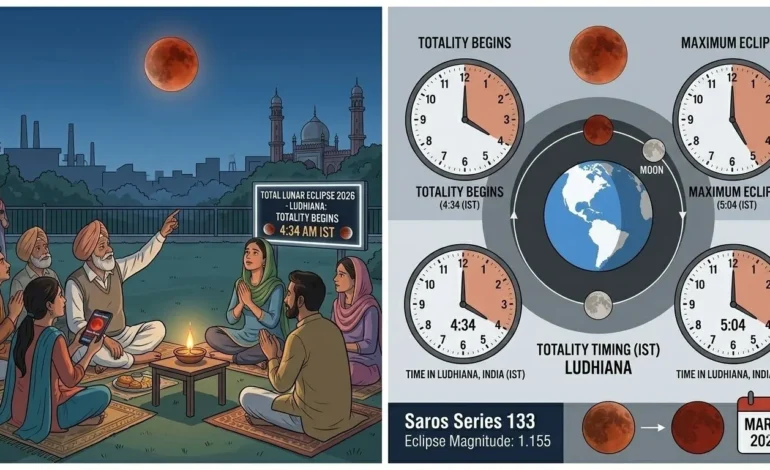

On March 3, 2026, skywatchers around the world will witness one of the most breathtaking celestial events of the year — the moon eclipse 2026, a deep Total Lunar Eclipse that will turn the Moon a stunning shade of red. Often called a “Blood Moon,” this rare astronomical event is even more special because it coincides with the vibrant Hindu festival of Holi.
Whether you are a science enthusiast, a spiritual observer, or simply someone who loves gazing at the night sky, this complete guide will help you understand everything about the moon eclipse 2026 — from the science behind it to the best places to watch it.
Table of Contents
What Is the Moon Eclipse 2026?
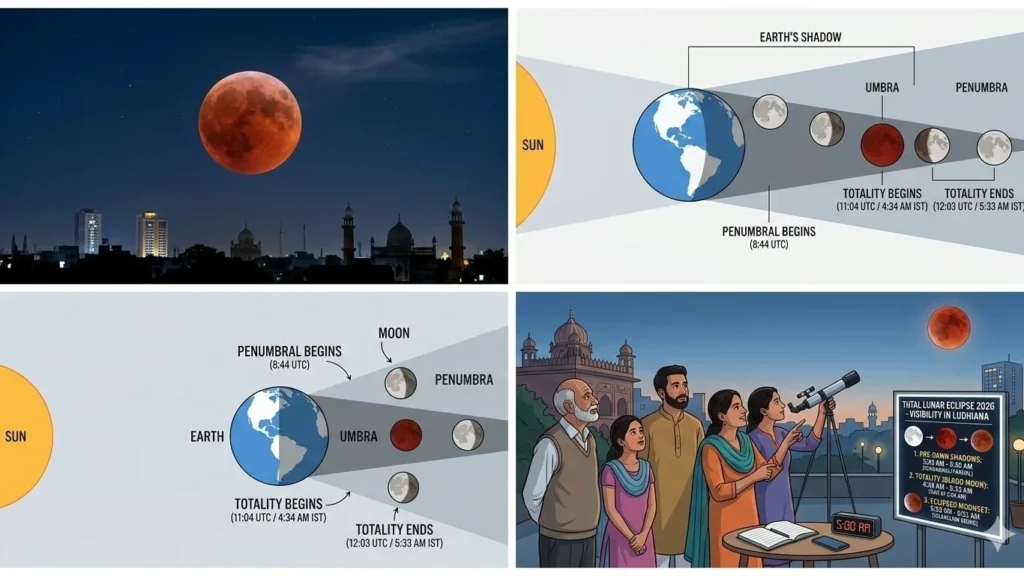
The moon eclipse 2026 is a Total Lunar Eclipse that will occur on Tuesday, March 3, 2026. During this event, the Moon will pass completely through Earth’s inner shadow, known as the umbra.
Unlike a solar eclipse, a lunar eclipse is completely safe to view with the naked eye. No special glasses are required.
This particular eclipse is significant because:
- It will last nearly 5 hours and 40 minutes from start to finish.
- The total phase will last about 58 minutes.
- It has an umbral magnitude of 1.155, meaning the Moon passes deep into Earth’s shadow.
- It belongs to Saros Series 133, a long cycle of repeating eclipses.
Why Does the Moon Turn Red?
During the moon eclipse, the Moon will glow in shades of red, copper, or orange. This happens because of Earth’s atmosphere.
As sunlight passes through the atmosphere, shorter blue wavelengths scatter (which is why the sky appears blue during the day). The longer red wavelengths bend around Earth and reach the Moon, illuminating it with a reddish hue.
This same effect creates red and orange sunsets. During totality, the Moon essentially reflects the combined glow of all the sunrises and sunsets happening around Earth at that moment.
Complete Timeline of the Moon Eclipse 2026 (UTC)
Here are the official stages of the eclipse in Universal Time (UTC):
| Eclipse Phase | Time (UTC) | What Happens |
|---|---|---|
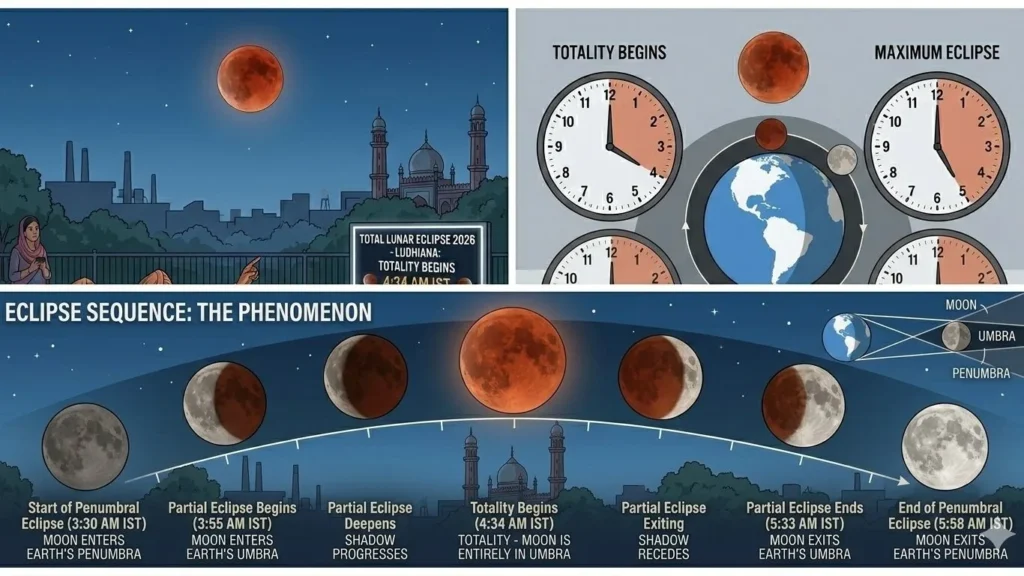
| Penumbral Eclipse Begins | 08:44 UTC | Moon enters Earth’s faint outer shadow. Slight dimming begins. |
| Partial Eclipse Begins | 09:50 UTC | A dark “bite” appears on the Moon as it enters the umbra. |
| Totality Begins | 11:04 UTC | The entire Moon is inside the umbra and turns red. |
| Maximum Eclipse | 11:34 UTC | Moon is deepest in Earth’s shadow. |
| Totality Ends | 12:03 UTC | Moon begins exiting the umbra. |
| Partial Eclipse Ends | 13:17 UTC | Moon leaves the dark shadow. |
| Penumbral Eclipse Ends | 14:23 UTC | Eclipse completely ends. |
The total phase lasting nearly 58 minutes makes this a deep and impressive eclipse.
Where Will the Moon Eclipse 2026 Be Visible?
A lunar eclipse is visible from anywhere on Earth where the Moon is above the horizon during the event. The moon eclipse strongly favors the Pacific region.
Best Views (Entire Eclipse Visible)
Observers in these regions will see the full event:
- Alaska
- Hawaii
- Western United States
- Western Canada
- Australia
- New Zealand
- Japan
- South Korea
- Eastern China
These areas will enjoy the entire total phase.
Visible During Moonset (Early Morning)
People in:
- Central and Eastern North America (New York, Chicago, Toronto)
- Much of South America
will see the early stages of the eclipse. However, the Moon will set before totality completely ends.
On the U.S. East Coast, something extraordinary may happen — a selenelion, where the eclipsed Moon and the rising Sun appear simultaneously on opposite horizons.
Visible During Moonrise (Early Evening)
Observers in Western Asia, including India, will see the Moon rise while the eclipse is already in progress. They will witness the final partial phases as the Moon emerges from Earth’s shadow.
Not Visible
The moon eclipse 2026 will not be visible from:
- Africa
- Most of Europe
- Western South America
The Holi Connection: A Rare Cultural Coincidence
One of the most fascinating aspects of the moon eclipse 2026 is its timing. It occurs during the same week as Holi, the famous Hindu Festival of Colors.
What Is Holi?
Holi is celebrated across India and in many parts of the world. It symbolizes the victory of good over evil and marks the arrival of spring. Celebrations include:
- Holika Dahan (bonfire ritual)
- Rang Wali Holi (festival of colors)
- Community gatherings and prayers
The coincidence of a Chandra Grahan (lunar eclipse) during Holi is considered rare and spiritually significant by many.
Religious and Cultural Observances in India
Because the moon eclipse 2026 aligns with Holi week, it introduces important traditions.
1. Sutak Period
In Hindu belief, the Sutak period begins several hours before a lunar eclipse. During this time:
- Temples may close temporarily
- Auspicious activities may be postponed
- Some rituals are paused
This could affect the timing of Holika Dahan and Holi celebrations.
2. Fasting and Dietary Traditions
Some people observe:
- Fasting (upavasa)
- Avoiding cooked food during eclipse hours
- Preparing fresh food after the eclipse ends
3. Spiritual Significance
A lunar eclipse is often seen as a powerful time for:
- Prayer
- Meditation
- Chanting
- Charity
For many, the moon eclipse 2026 is not just an astronomical event but also a spiritually reflective moment.
Scientific Significance of This Eclipse
This eclipse has an umbral magnitude of 1.155, meaning the Moon will travel deeply into Earth’s shadow. The deeper the Moon enters the umbra, the darker and redder it may appear.
Because it belongs to Saros Series 133, it is part of a long-term pattern of eclipses repeating roughly every 18 years.
Astronomers are particularly interested in how atmospheric conditions affect the Moon’s color. Dust, pollution, and volcanic particles can influence how dark or bright the red shade appears.
How to Safely Watch the Moon Eclipse 2026
Unlike solar eclipses, the moon eclipse 2026 is completely safe to watch with the naked eye.
No protective glasses are needed.
Tips for Best Viewing:
- Find a location with a clear view of the horizon
- Avoid city light pollution if possible
- Use binoculars to see surface details
- A telescope will enhance the red color and lunar craters
- Check local weather forecasts
If you are in India, look toward the eastern horizon during moonrise to catch the partial phase.
Photography Tips for the Blood Moon
If you want to capture the moon eclipse 2026:
- Use a tripod for stability
- Set camera to manual mode
- Use a zoom lens (200mm or higher)
- Lower ISO for sharper images
- Adjust shutter speed during totality
The red glow during maximum eclipse at 11:34 UTC may offer the best photo opportunity.
Why the Moon Eclipse 2026 Is Special
This eclipse stands out because:
- It is a deep total lunar eclipse
- It lasts nearly 6 hours overall
- It coincides with Holi
- It may create a rare selenelion for East Coast viewers
- It will not be repeated on a similar scale until 2028
The combination of astronomy and cultural tradition makes it a once-in-a-generation experience for many.
When will the moon eclipse 2026 occur?
The moon eclipse 2026 will take place on Tuesday, March 3, 2026. The total lunar eclipse will begin at 08:44 UTC and end at 14:23 UTC, with totality lasting approximately 58 minutes.
What type of eclipse is the moon eclipse 2026?
The moon eclipse 2026 is a Total Lunar Eclipse, meaning the Moon will pass completely through Earth’s inner shadow (umbra), causing it to turn red.
Why is the moon eclipse 2026 called a Blood Moon?
It is called a Blood Moon because the Moon appears reddish-orange during totality. This happens when Earth’s atmosphere filters sunlight, scattering blue light and allowing red wavelengths to illuminate the Moon.
Is the moon eclipse 2026 safe to watch with naked eyes?
Yes, the moon eclipse 2026 is completely safe to watch with the naked eye. Unlike a solar eclipse, no protective glasses are required.
How long will the total phase of the moon eclipse 2026 last?
The total phase (totality) of the moon eclipse 2026 will last about 58 minutes, while the entire eclipse event will span nearly 5 hours and 40 minutes.
Where will the moon eclipse 2026 be visible?
The full eclipse will be visible from regions around the Pacific Ocean, including:
Western United States and Canada
Alaska and Hawaii
Australia and New Zealand
Japan, South Korea, and Eastern China
Parts of North America and India will see partial stages of the eclipse.
Will the moon eclipse 2026 be visible in India?
Yes, in India the Moon will rise while the eclipse is already in progress. Observers will see the final partial phases as the Moon emerges from Earth’s shadow.
What is the connection between the moon eclipse 2026 and Holi?
The moon eclipse 2026 coincides with the week of Holi, the Hindu Festival of Colors. This rare timing adds cultural and spiritual significance, especially in India where lunar eclipses (Chandra Grahan) are considered important celestial events.
What is the Sutak period during the moon eclipse 2026?
The Sutak period is a traditional Hindu observance that begins several hours before a lunar eclipse. During this time, some people avoid auspicious activities and follow spiritual practices until the eclipse ends.
When is the next total lunar eclipse after 2026?
The next major total lunar eclipse visible on a similar scale is expected in 2028, making the moon eclipse 2026 a must-watch celestial event.